Emor rmx (Speak) |
|
Download: |
|
|
May 14, 2005 Saturday - AM |
By Rabbi Ackerman |
Emor rmx (Speak) May 14, 2005
Shabbat Morning
Torah: Leviticus 21:1 - 24:23
Haftarah: Ezekiel 44:15-31
K'tuvim Notzrim: Matthew 5:38-42
All of us adults have been through an early, awkward phase of life, one which is sometimes termed "growing pains." This is frequently a time of frustration and disillusionment to the young person whose body and mind are undergoing rapid changes. This whole process is of course one of the miracles of life which HaShem has built into his creation. It provides for not only physical growth, but also mental and spiritual growth; a change from youth to adult. As an event in a person's life it is frequently traumatic. We tend to look at ourselves as "ugly ducklings," not realizing that soon we will become "beautiful swans." And the end result is frequently very positive, but can be equally disastrous for some. What makes a person go through this stage and become a Ted Bundy? Or this most recent serial killer, BTK, the churchman, youth worker, and family man? Profiling of these killers has revealed a set of characteristics which are usually common to each. These traits include disorganised thinking, thinking which is overloaded toward self-gratification. It frequently includes bipolar mood disorders, the radical swings from high to low and back again. Also there is often a feeling of resentment towards society, a resentment brought on by their own failings. Sexual frustrations and an inability to be social or socially accepted are also included. Sometimes there are over-bearing parents, parents who do not constructively lead their child and only roughly criticize. Last, but not least, there may be a wild imagination that tends to drag them into a fantasy world. Dwelling on fantasy as provided by video games and the recent books and movies about young sorcerers carries this individual into a false reality.
Remember, we are talking about serial killers here and not the average young person going through "growing pains." The positive influence of parents was in most cases missing from these persons lives. This is not to say that some turned out bad anyway, even
hough their parents tried their best to be a good influence. But in most cases we would find that these parents did not "train up a child in the way he should go." Proverbs 22:6 tells us that if we do that, that is, "train up a child in the way he should go," then the result will be "and, even when old he will not swerve from it."
This is not a problem for you parents here in Beit Shalom. You know the Scriptures and understand that training up a child in the way that he should go refers to "teaching him to follow Torah." Proverbs 13:24 also gives you sound advice. He who spares his rod hates his son, But he who loves him disciplines him diligently. The word "rod" is the Hebrew word "shebet," and usually means rod, staff, or club. This is apparently the p'shat, the plain meaning of the phrase; children are to be disciplined. But a secondary meaning of the word is that of correction, and this means that the child is to be corrected by the teachings of Scripture, the Torah, to be shown the truth as opposed to the false understanding.
Everything that we need for life is found in the Word of God. Even the ancient rabbis discovered the need to teach a child so that they would grow up to be God-fearers and productive citizens of the community. In Pirkei Avot, The Ethics Of The Fathers, we see that in ancient times there was a set pattern by which children were taught. A five year old begins Scripture; a ten year old begins Mishnah; a thirteen year old becomes obliged to observe the commandments; a fifteen year old begins the study of Gemara; an eighteen year old goes to the marriage canopy; and a twenty year old begins pursuit of a livelihood. These may not be the same areas which our youth study, but the ages are very appropriate even today, except that the marriage and work ages are culturally different today. We would say that five years old is a good age to begin the study of Scripture. However, the idea of a thirteen year old becoming obliged to observe the commandments is a little different in ancient Jewish thought. This goes along with the idea back then that a child before 13 was not responsible for his actions before HaShem. It was as if he was an infant and incapable of determining right from wrong. But at 13, he was deemed able to make that distinction and thus became responsible for his own actions. Today we tend to say that a child of 4 or 5 can make a rational decision for Messiah Yeshua as Savior. In the case of some children this is true. But this action also makes them responsible for their sins, their transgressions of the Torah, to HaShem. In these cases it is imperitive that the parents teach the child that repentance of their small sins is uppermost. If they learn early that they must ask Messiah for forgiveness, then they are on the straight path toward a well balanced life for themselves, their parents, and before HaShem.
Regarding disobedience and crime, we find in our parashah today a very difficult passage. It is one which is frequently misunderstood; one which leads many to categorize HaShem as the "harsh God of the Old Testament." Leviticus 24:17 reads: Anyone who strikes another person and kills him must be put to death. This we can understand, and our moral and criminal codes are based upon that understanding. This is what we would call pre-meditated murder. Verse 18 says: Anyone who strikes an animal and kills it is to make restitution, life for life. This also is easy to understand. We must make restitution for that which we destroyed. But then in verses 19 and 20 we encounter the difficult part: If someone injures his neighbor, what he did is to be done to him; break for break, eye for eye, tooth for tooth; whatever injury he has caused the other person is to be rendered to him in return. In the Complete Orthodox Bible it is rendered: 19 And if a man cause a mum in his neighbor; as he hath done, so shall it be done to him; 20 Fracture for fracture, eye for eye, tooth for tooth; as he hath caused a mum in an adam (a man), so shall it be done to him. Ve'ish ki-yiten mum ba'amita ka'asher asah ken ye'aseh lo. A "mum," is a blemish or defect and means the same as "an injury." But is this what we are to understand that HaShem is saying here? Does HaShem require that a man's eye be put out if he puts out the eye of a neighbor in a fight? Or does he require that a man who stabs another with a knife be stabbed in the same way? Those who interpret the Torah as old, passed away, and the words of a harsh God would use this as their excuse to say that they are no longer required to follow it.
But we have been shown that we cannot always take English words in our Bibles at face value. We must look at the underlying Hebraic meaning many times in order to get the best understanding of a passage. And of course, one of our best sources for this is Yeshua our Messiah, the Torah Teacher par excellence. He explained Torah to us and in Matthew 5 he amplifies Leviticus 24:19 and 20. But even then it is difficult to understand as read in most Bibles. In the Complete Jewish Bible, Matthew 5:43 we read: You have heard that our fathers were told, 'Love your neighbor and hate your enemy.'" Can we take it for granted that Torah says that we are to hate our enemies? I have not been able to find it. Yeshua said: You have heard that our fathers were told. And then he says: But I tell you, love your enemies. Yeshua is saying, "Your religion system teaches you that you are to hate your neighbor, but I say that you should love them." He is not comparing himself with the Torah and he is not raising the standard higher that HaShem set it in the Torah. He is not talking about what Moses said in Parashah Emor. Yeshua is talking about what the religious system taught them. Read critically. Don't just assume Yeshua is speaking words from the Torah. If he came to fullfill the Torah then he wouldn't change a mitzvah. He came to plêroô it, as the Greek says, that is, he came to make it full, to complete it, to accomplish it, or to fully carry it out. And what he is doing here is giving us a drash on Parashah Emor. Going back to 5:38 we hear Yeshua saying: You have heard that our fathers were told 'Eye for eye and tooth for tooth.'" But I tell you not to stand up against someone who does you wrong." Taking 'Eye for eye and tooth for tooth' first, we recognize this as remez. Yeshua is referring to Leviticus 24:19-20. This meant that the injurer must offer financial restoration to the injured before a judge. This is the "measure for measure" which Yeshua recommended in Matthew 7:2, Mark 4:24, and in Luke 6:38. This humanitarian rule is "compensation for damages and pain in cases of bodily injury." Eye for eye and tooth for tooth cannot mean that a person can inflict injury if he is injured. Revenge is expressly forbidden in the Torah. Leviticus 19:18 says that: You shall not take vengeance, nor bear any grudge against the sons of your people, but you shall love your neighbor as yourself. So we see that we have to look deeper in order to get the real intent of Scripture.
But what then, does Yeshua mean when he says: But I tell you not to stand up against someone who does you wrong. On the contrary, if someone hits you on the right cheek, let him hit you on the left cheek too? Does this mean that Yeshua is teaching pacifism? Is he teaching that we should not defend ourselves when attacked; that we should just watch if our family member or our neighbor is being assaulted? This cannot be true because it says in Leviticus 19:16 ....you are not to act against the life of your neighbor. This is also understood to mean that we are not to take an inactive stance if the life of our neighbor is in danger. The Talmud in Sanhedrin 73a speaks similarly: "Anyone who sees another drown in the river or dragged away by a predatory beast or threatened by robbers is obliged to rescue him." What might have Yeshua have meant "by not resisting someone who does you wrong?" Could he could have been referring to Psalm 37, verse 8 which says: Stop being angry, put aside rage, and don't be upset; it leads to evil? The intent of this verse is referred to by Yeshua in 5 other verses in the Sermon on the Mount; 5:9, 11, 21, 22, and 29. And what they all mean is "do not compete with another in doing injustice." This means that we are to escape from the vicious cycle of doing injustice for injustice by preventing evil by doing kindness. This also means that we are to set an example of good rather than passively letting a person continue to assault us. Evil is contagious, but good is also. Yeshua does not mean here that we are to be in compliance with the wicked, but that we are to battle injustice with justice and to battle lies with truth. He is saying, "Your standard is too low. You only worry about murder, while HaShem looks at the heart and says if there's hate there, it's the same thing. You only worry about fornication, while HaShem says that if there's lust in the heart, it's the same thing." HaShem's standard is an attitudinal standard; He is interested in our attitude. Yeshua is saying here that the standard of the religious system of that day was only dealing with action. That's the difference. The internal things are what HaShem is really looking for."
Sha'ul presented this ethic perhaps in a better way than Matthew did. In Romans 12:21 he said: Do not be overcome by evil, but overcome evil with good. Shimon Kefa said something similar in his first letter in 2:15: For such is the will of God that by doing right you may silence the ignorance of foolish men. If we were to sum up what Yeshua said in this passage in Matthew, it would probably be: "Resist evil by kindness."
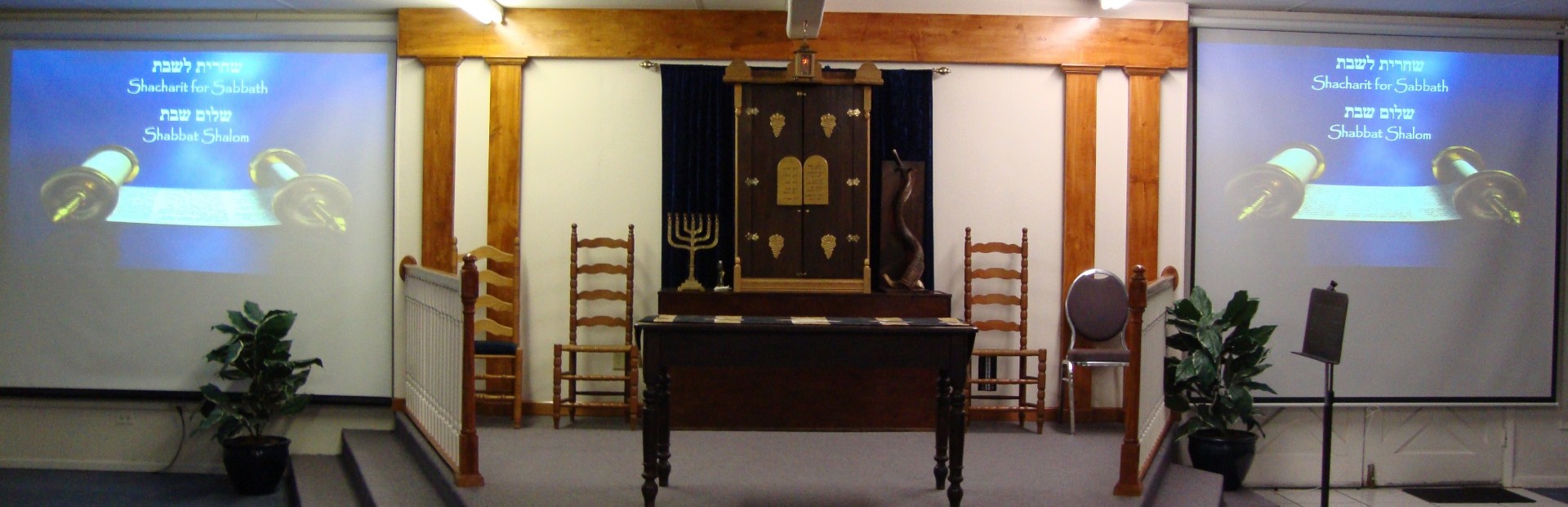
Let's go back for a moment to our opening remarks about growing pains. In a sense that is what we are facing here at Beit Shalom. We have been going through an intensive period of work and changes, just as our bodies did long ago during that difficult growing up time. And we now have a beautiful new facility that we are unsure how operate. This is similar to the mature body we had developed when our minds had not matured as quickly. We needed guidance from our parents to allow our immaturity to become maturity. In a similar way we really need to have guidance from HaShem as we begin to put plans into operation here in this new building. We are accustomed to being limited in ministry by the small building we were in, even though we were tremendously blessed by His presence there. As we proceed through these growing pains, the determining of ministry and programs that we are to institute, we must be careful not to rush, but rather let HaShem guide us as we make that change from "ugly duckling to swan." As we grow into this building, it will not feel the same as the comfortable place from which we came. It is not as cosy as that one was, but it will become just as comfortable as we continue to seek HaShem. Let's patiently continue to pray for wisdom as we move forward in ministry here; as we go through our "growing pains."
The facility that we have now is seen as a huge success in the eyes of HaSatan and he is fearful of the victories for HaShem which are coming. He is attacking us in a cowardly way. Rather than attack us as a unified group he is attacking our individual families. Many of us are undergoing severe challenges. He knows that if he can take us out one by one, he can diminish our effectiveness for HaShem. But we know and recognize these attacks for what they are, spiritual attacks from the Evil One.
You all know Ephesians 6:11-12 very well. Use all the armor and weaponry that God provides, so that you will be able to stand against the deceptive tactics of the Adversary. For we are not struggling against human beings, but against the rulers, authorities and cosmic powers governing darkness, against the spiritual forces of evil in the heavenly realm. When Daniel prayed to HaShem for an answer it did not come for 21 days because the angel delivering the answer, we presume it was Gabriel, had been in battle with the Prince of the Kingdom of Persia. This demonic ruler who had been placed there by HaSatan to thwart the work of HaShem was so powerful that Gabriel had to have Michael, one of the chief angels, come to his aid. If these demonic beings are so powerful, what chance do we have in resisting and defeating them? Our chances are great. We can defeat them. Ya'acov, James, tells us in 4:9: Therefore, submit to God. Moreover, take a stand against the Adversary and he will flee from you. Resist him! You know the weapons which we have. They are found in Ephesians 6:13-18. This begins: So take up every piece of war equipment God provides; so that when the evil day comes, you will be able to resist; and when the battle is won, you will still be standing.
This war equipment is of two types, defensive and offensive. Just as a baseball glove is used for defense and a bat for offense, so these weapons are for different purposes. A piece of armor, the breastplate, is defensive. It is righteousness. We have previously described righteousness as being faithful to the Torah. When we seek to honor HaShem's mitzvot we strengthen our breastplate of righteousness. We wear on our feet the readiness that comes from the "Good News of Shalom." This readiness comes from being in relationship with Yeshua through the Good News which he offered us. He is our Messiah and responds to the prayers of his talmidim, his disciples. And let us not forget that there is power in the name of Yeshua, the name above all names, which we have been given to combat the enemy. The shield of trust or faith is also defensive. We have faith that HaShem will protect us from the Evil One. The helmet of deliverance protects our heads from the assault of HaSatan. Specifically, our minds are subject to waver without guidance, but are strengthened against the weak thoughts of defeat by knowing that our Father is the creator of the universe. He holds all power and will ultimately defeat the Enemy. And he has given us the tools needed to protect ourselves. The belt of truth buckled around our waist is a defensive weapon, but more importantly, it holds up our offensive weapon. The one offensive weapon is the Sword of the Spirit, the Word of God. With this weapon we slash HaSatan's assault to ribbons. Just as Yeshua quoted Scripture to HaSatan in the wilderness, so we must do. As Ya'acov said "Resist the Devil and he will flee from you." Resist him with the Word.
And remember that we are family. When one suffers we all suffer. Do not hesitate to ask for help from your fellow talmidim or from me. We have the victory in Yeshua our Messiah. It might not be immediate, but as we persevere together we will win. And HaShem's Word will be shown to be true. We look forward to great victories over HaSatan for Messiah. Think of the Israelites as they marched forward through the wilderness. As we continue to move forward in that same way we must keep ourselves gathered into a strong and cohesive unit so that HaSatan cannot attack us. If we have stragglers on the sides or rear of our marching column, they are easy prey for HaSatan just as the Israelite stragglers were killed by the devious Amalekites. To remain a strong and effective unit for HaShem we must not neglect the needs of any that He has given us. When we are all free from HaSatan's attacks we can more effectively do what Sha'ul speaks of in Romans 1:16: For I am not ashamed of the Good News, since it is God's powerful means of bringing salvation to everyone who keeps on trusting, to the Jew especially, but equally to the Gentile. And these words demonstrate what we have been called to be here in Beit Shalom, the
Israel of HaShem. As Jews and Sojourning Gentiles in Israel we are priests to the Nations, speaking truth to all of the Good News revealed in Yeshua; that how through Yeshua we can walk victoriously in the Commands of HaShem, His Torah. If HaSatan keeps us weak and wounded we cannot be effective cohanim. We cannot minister with the strength with which we are capable. So build each other up that we might do HaShem's will.
Avenu, Malkeinu, our Father our King: We ask for your wisdom as we complete the restoration of this facility which you have given us. Help us to not rush into doing things without the confirmation of Your Spirit. Your guidance is imperative Father. As children growing into adults, we are immature with regard to what we are to do in a such a large, beautiful facility. We wait upon you Lord. We wait for You to show us how we are to minister to not only those of us who are already here, but how to minister to those that you are going to send. We want to do Your will Father, not only your permissive will, but your perfect will for Beit Shalom. And Father, please help us to minister to each other in our challenges and help us to grow stronger and stronger through Yeshua our Messiah. Through him may we become more and more resistant to the attacks of the spiritual forces of evil brought against us by HaSatan. May we make the weapons of Ephesians 6 which you have given us to be extremely strong against HaSatan. Blessed be HaShem the God of Israel from eternity past to eternity future. B'shem Yeshua; in the name of Yeshua our Messiah, Amen.
© Beit Shalom Messianic Synagogue
Permissions: You are permitted and encouraged to reproduce and distribute this material in any format provided that you do not alter the wording in any way and do not charge a fee beyond the cost of reproduction. For web posting, a link to this page on our website is perferred. Any exceptions to the above must by approved by Beit Shalom Messianic Synagogue
Please include the following statement on any distributed copy: By Rabbi Ackerman © Beit Shalom Messianic Synagogue. Website: www.beitshalom.us